What are VRF/VRV Systems?
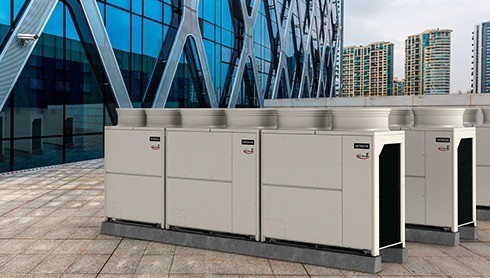
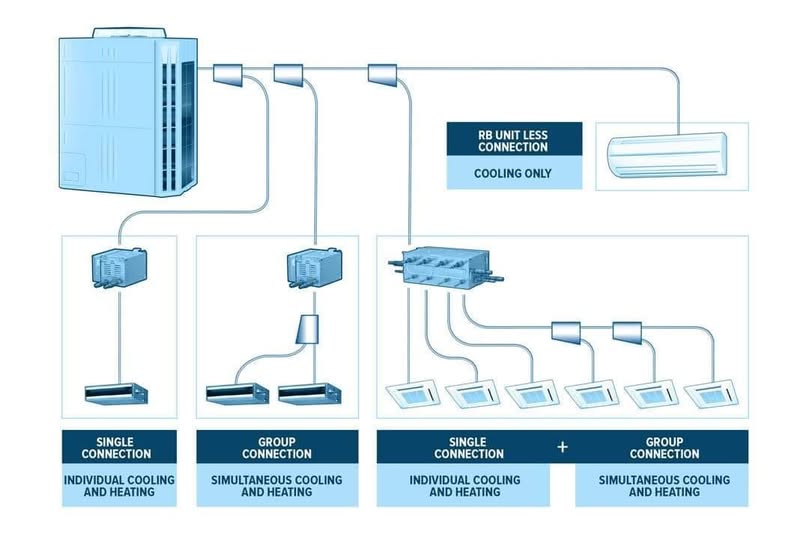
VRF (Variable Refrigerant Flow) or VRV (Variable Refrigerant Volume) systems are advanced central air conditioning systems that distribute refrigerant directly to multiple indoor units from a single outdoor unit.
Basic Components of a VRF System
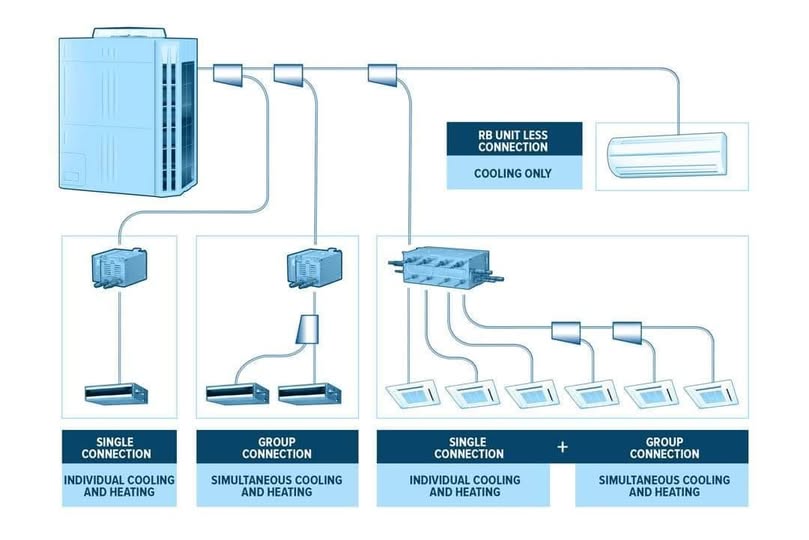
- Outdoor Unit: Contains the compressor and the main heat exchanger.
- Indoor Units: Multiple types (ceiling, wall-mounted, floor, ducted).
- Electronic Expansion Valves (EEVs): Control refrigerant flow to each indoor unit.
- Central Controller: For controlling all units from a single location.
Types of VRF Systems
- 2-Pipe VRF System: Operates in either cooling or heating mode at a time.
- 3-Pipe VRF System: Simultaneous cooling and heating for different units.
- Heat Recovery VRF System: Recovers waste heat for reuse.
Advantages of VRF Systems
- ✅ High energy efficiency: EER can reach 4.5 in some models.
- ✅ Quiet operation: Very low noise level (28-35 dB).
- ✅ Design flexibility: Indoor units can be installed over long distances (up to 150 meters).
- ✅ Independent control: Each indoor unit has separate temperature control.
- ✅ Space saving: No need for a central machine room.
Disadvantages of VRF Systems
- ❌ High initial cost: 20-30% higher than conventional systems.
- ❌ Specialized maintenance: Requires specially trained technicians.
- ❌ Sensitivity to refrigerant leaks: Can affect the entire system.
- ❌ Difficult expansion after installation: Adding new units is limited.
Comparison Table: VRF vs Conventional Systems
| Feature | VRF System | Split System | Central System |
|---|---|---|---|
| Energy efficiency | ⭐⭐⭐⭐⭐ | ⭐⭐⭐ | ⭐⭐⭐⭐ |
| Control flexibility | ⭐⭐⭐⭐⭐ | ⭐⭐⭐ | ⭐⭐ |
| Initial cost | ⭐⭐⭐ | ⭐⭐⭐⭐⭐ | ⭐⭐⭐ |
| Maintenance ease | ⭐⭐⭐ | ⭐⭐⭐⭐ | ⭐⭐⭐⭐ |
VRF System Design and Installation Tips
- 📏 Accurately calculate the heat load for each zone separately.
- 📍 Choose the outdoor unit location with adequate ventilation.
- 🔧 Use insulated copper pipes with appropriate thickness (13-19 mm).
- ⚡ Ensure a suitable power supply (380-415V three-phase).
- 📡 Design the control system according to end-user needs.
💡 Expert Tip: VRF systems are the ideal choice for medium-sized buildings (500-5000 m²) such as hotels, office buildings, and hospitals.